
Learning-Based Dual-Robot 3D End-Effector Tracking
Completed
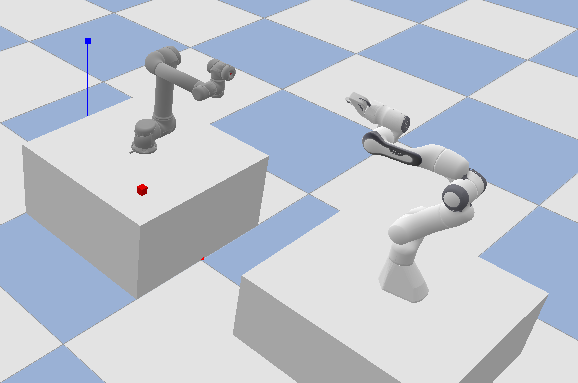
PyBullet dual-arm simulation with a UR5 leader and Franka Panda visual tracker.
Summary
Built a simulated dual-robot end-effector tracking system in PyBullet. A UR5 picks up a red target object and drives it through a time-varying 3D trajectory, while a Franka Emika Panda tracks the moving target from its wrist-mounted RGB-D camera. The project now supports two interchangeable follower controllers: a frozen PD visual-servoing baseline and a learned PPO reinforcement-learning policy.
- Robots: UR5 leader and Franka Emika Panda follower
- Repository: GitHub
- Environment: PyBullet with custom URDF assets and Gymnasium-compatible RL wrapper
- Baseline Controller: RGB-D visual servoing with axis-wise PD correction and inverse kinematics
- Learning Controller: Stable-Baselines3 PPO policy producing Cartesian end-effector displacement commands
- Observation Design: 17-D compact vision state
- Evaluation: RMSE/MAE along relative X, Y, Z
Simulation Videos
Final PPO policy tracking the full XYZ trajectory
PD visual-servoing baseline on the same dual-arm task
System Overview
The setup tests decentralized coordination between two independent robot arms. The UR5 acts as the leader and executes a precomputed motion, while the Franka acts as the follower and receives only visual information from its own end-effector camera.
- Robot A - UR5: grasps a red cube using a fixed PyBullet constraint, then follows a repeatable Cartesian trajectory.
- Robot B - Franka Panda: observes the cube through a wrist RGB-D camera and uses IK to convert Cartesian tracking commands into joint targets.
- Communication Model: no joint states or control signals from Robot A are passed to Robot B; the follower tracks what it can infer from vision (decentralized control)
- Trajectory: alternating circular and Lissajous/figure-eight Y-Z motion combined with sinusoidal X motion.
The UR5 trajectory is precomputed with inverse kinematics before execution, which keeps the target motion repeatable and reduces runtime latency during controller comparison.
Controller Stack
The project separates target perception, tracking policy, and robot actuation so that the same simulator can run either the classical baseline or the learned policy.
RGB-D camera -> red-object detection -> tracking policy -> Cartesian displacement -> IK -> Franka joints
PD Baseline
A PD controller is created and tuned as a baseline. It segments the red target using HSV thresholding, reads depth at the detected target object centroid, low-pass filters the pixel/depth error, and applies an axis-wise PD correction in camera coordinates before transforming the command into the PyBullet world frame.
| Axis | P Gain | D Gain |
|---|---|---|
| Camera X | 0.001 | 0.0005 |
| Camera Y | 0.001 | 0.0005 |
| Camera Z / Depth | 0.25 | 0.04 |
The baseline achieved centimeter-level tracking on the original trajectory, with mean absolute error below 1.9 cm across the global axes.
PPO RL Controller
The learned controller uses PPO from Stable-Baselines3. Instead of directly consuming rendered images, the policy receives compact visual features and robot state terms, then outputs a continuous Cartesian displacement command:
vision features -> PPO policy -> [dx, dy, dz] -> scaled Cartesian command -> IK
The action is clipped to [-1, 1] per axis and scaled by 0.02 m, giving the policy bounded, smooth end-effector corrections. The same policy wrapper can run in yz, x, or xyz action modes, which made it possible to stage training from easier planar tracking to full 3D tracking (curriculum learning).
Observation and Reward Design
The PPO policy uses a 17-dimensional observation vector:
| Feature Group | Dimension |
|---|---|
| Normalized pixel/depth error | 3 |
| Change in visual error | 3 |
| Detection flag, blob area, normalized depth | 3 |
| Franka end-effector velocity | 3 |
| Previous action | 3 |
| Trajectory phase sin/cos | 2 |
Ground truth is used for reward calculation and evaluation, but not as a policy observation. This keeps the learned controller closer to the visual-servoing setup while still allowing precise training signals.
The reward separates planar Y-Z tracking from relative X tracking. Because the robots are physically offset along the world X axis, X is evaluated as relative displacement: the Franka is rewarded for matching the target’s sinusoidal X motion while preserving the initial robot-to-robot spacing.
r =
  - w_x_pos  * e_x_rel^2
  - w_yz_pos * e_yz^2
  - w_x_vel  * v_x_error^2
  - w_yz_vel * v_yz_error^2
  - 0.05 * ||action||^2
  - 0.20 * ||action - previous_action||^2
The reward also includes a small bonus for tracking error below 2 cm and a penalty when active tracking error exceeds 45 cm.
Curriculum Learning
Training was staged as a simple curriculum:
- Y-Z curriculum policy: train the Franka to track the circular and figure-eight motion in the image plane while masking X actions.
- Full XYZ fine-tuning: initialize from the Y-Z policy, enable all action axes, and increase reward emphasis on maintaining Y-Z behavior while learning relative X tracking.
| Model | Purpose |
|---|---|
curriculum_model_rl_yz.zip |
Midway policy for planar Y-Z tracking |
final_model_rl_xyz.zip |
Final policy for full 3D tracking |
Results
The PD baseline provided a stable reference controller, while the PPO implementation expanded the project into a learning-based tracking framework with swappable policies, curriculum training, and robustness testing hooks.
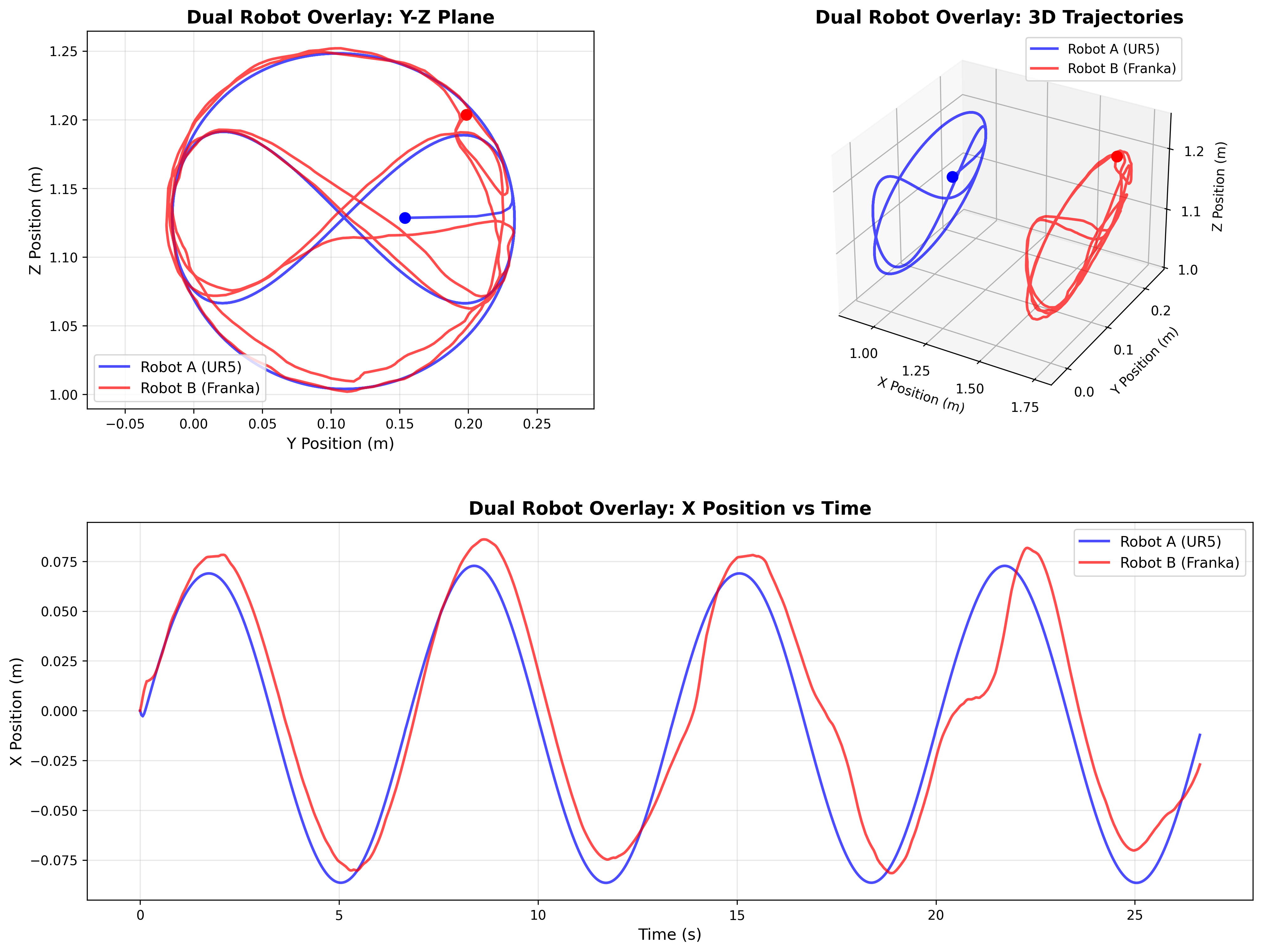
Tracking overlay for the UR5 leader trajectory and Franka Panda follower trajectory.
| Baseline Axis | MAE [m] | RMSE [m] |
|---|---|---|
| X / Depth | 0.01689 | 0.02037 |
| Y / Horizontal | 0.01406 | 0.01542 |
| Z / Vertical | 0.01807 | 0.02196 |
Tools and Libraries
- PyBullet for physics simulation, robot loading, camera rendering, constraints, and inverse kinematics
- Gymnasium for the reinforcement-learning environment interface
- Stable-Baselines3 PPO for training and deploying the learned tracking policy
- OpenCV for HSV color segmentation and RGB-D target detection
- NumPy for trajectory generation, reward computation, and metric evaluation
- TensorBoard for training diagnostics
Technical Takeaways
- A well-tuned PD controller is a strong baseline for bounded visual tracking, but it becomes sensitive to depth noise, latency, and high-curvature transitions.
- Compact vision features gave PPO enough information to learn smooth tracking without the cost of image-based policy training.
- Curriculum learning made full 3D control easier: the policy first learned stable planar behavior, then adapted to the harder relative-depth component.